
Q2 Office: An Uptick in Absorption Amid Construction Decline

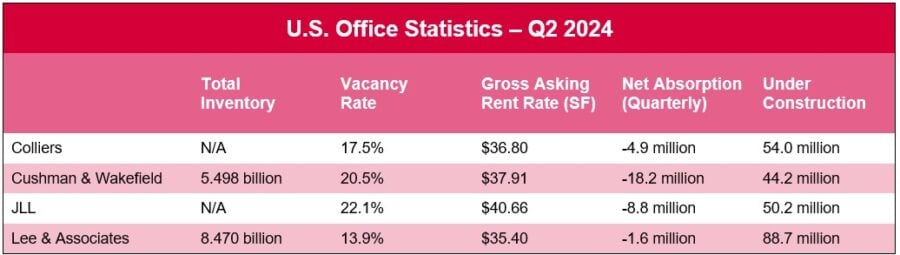
On the surface, U.S. office metrics for Q2 2024 might seem grim, with continued double-digit vacancy, ongoing negative absorption and sluggish rent growth. “The U.S. office market continued to experience the post-COVID slowdown that started in 2020,” according to Colliers’ Office Market Statistics Q2 2024 report. Fundamentals remained soft, new construction starts stopped in most cases, and concession packages were at an all-time high.”
Now, for some good news. Analysts issuing reports discussed an increase in overall absorption, a decrease in construction and a slow but steady rebalancing.
The Hybrid Work Scenario
One thing that’s taking place is that hybrid work recalibration is finally settling down. “Return-to-office rates continue to stabilize as most private employers have solidified office attendance over the past two years,” JLL’s U.S. Office Market Dynamics for Q2 report noted. The result is that the sector is approaching a new equilibrium.
JLL also commented that leasing strategies are shifting “as both tenants and landlords seek to avoid higher costs of capital associated with elevated interest rates.” This is leading to lower TI allowances, meaning an uptick in tenant renewals. “Other pre-built spaces, including spec suites and high-quality sublease listings, are also leasing up at an accelerated pace as tenants avoid upfront costs,” JLL said.
Another positive aspect of hybrid work stabilization is that it’s providing a baseline for space requirements, according to Cushman & Wakefield’s U.S. National Office Marketbeat for Q2 2024. The report indicated that attendance is stabilizing in the 60%- 70% range on peak attendance days. “Cushman & Wakefield’s current base case calls for occupancy to begin to stabilize in the second half of 2025, as hybrid space recalibration slows down and both headcount growth and new business formation create office demand,” Cushman & Wakefield analysts added.
Negative Absorption on the Wane
Most of the Q2 office absorption totals had a “negative” sign before them. On the positive side, negative absorption is declining. Lee & Associates’ Q2 2024 Market Report said that absorption improved by 28% year-over-year, while JLL’s figures were closer to a 50% YoY improvement. Cushman & Wakefield added more positive news, pointing out that Q2 absorption was positive in one-third of the U.S. office markets.
Cushman & Wakefield also pointed out that the market is no longer bifurcated, but trifurcated when it comes to performance and rents. “The best product is performing well with minimal vacancy,” the analysts commented. “Obsolete product may require investment or conversion, and the middle market faces a highly nuanced outlook with both opportunities and challenges in the years ahead.”
Also on the Wane: Construction
One factor helping with absorption is a construction reduction. Supply has dwindled across all CRE product types because of inflation, market fundamentals and the ongoing high cost of capital. As a result, “new construction is down,” with new added inventory at its lowest rate since 2013, according to the Lee & Associates analysts. JLL analysts agreed, pointing out that “over the past 12 months, the U.S. has seen the lowest volume of office construction starts on record,” with the pipeline falling nearly 70% since 2019.
Cushman & Wakefield analysts believe deliveries will likely dwindle in the near term, though strong demand continues for new, high-quality space. While the pipeline suggests that underbuilding could be a factor, “lower delivery totals should help the broader market recover, giving existing buildings time to stabilize occupancy with less competition from new construction,” the analysts said.


